
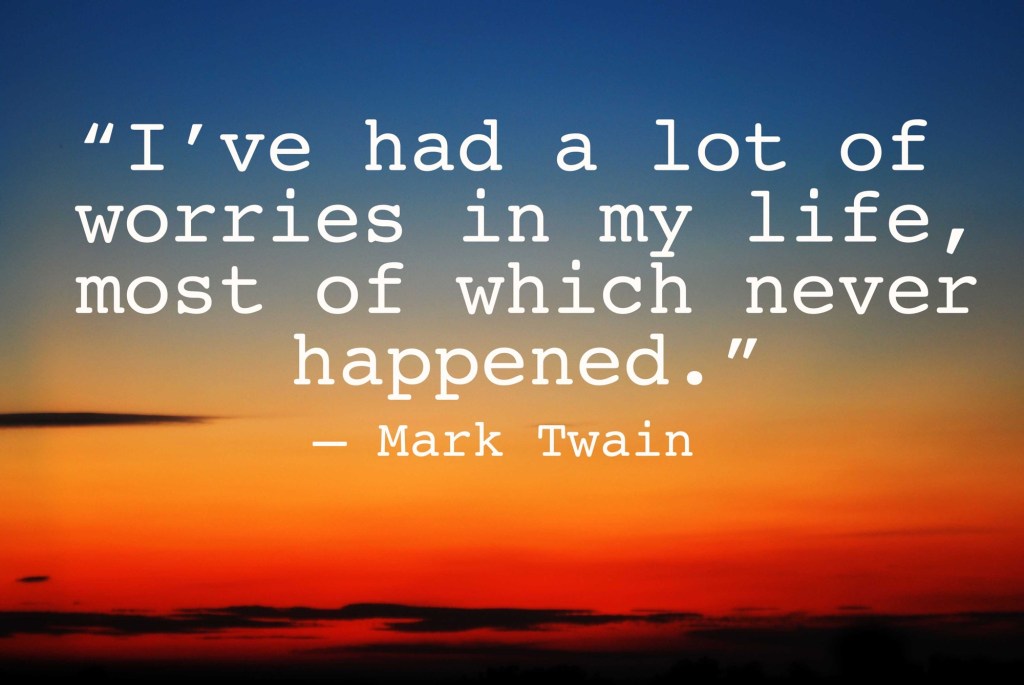
As the day’s last light paints the horizon in shades of fire and gold, a profound truth hangs in the sky, captured in the timeless words of Mark Twain: “I’ve had a lot of worries in my life, most of which never happened.” This simple yet striking image, with the quote superimposed on a tranquil sunset, speaks volumes about the human condition.
The human brain is wired to detect and respond to threats, a survival mechanism rooted in our evolutionary past. This system, primarily involving the amygdala and other areas of the limbic system, activates the “fight or flight” response when it perceives a threat. Crucially, this response can be triggered by both real and imagined threats. The brain often does not differentiate between a bear charging at us and a worry about a future event that might never happen.
The challenge arises in our modern world, where threats are less about immediate physical danger and more about complex, often psychological or emotional challenges. The brain’s threat detection system can misinterpret these modern ‘threats’, such as a stressful email or a social situation, as being as dangerous as a physical threat, leading to anxiety and catastrophic thinking.
Mark Twain, an author known for his sharp wit and deeper insights into life, encapsulates a universal human experience. The sunset backdrop is symbolic; just as the sun sets to rise again, our worries often fade, revealing that many of our fears are as fleeting as the day. Twain’s words remind us of the futility of excessive worry. Most of the troubles we agonize over never come to pass, and even those that do are often not as catastrophic as we fear.
The image itself, a serene end-of-day sky, suggests peace and closure. It’s a visual pause, an invitation to reflect on the day that’s passed and to let go of the anxieties that plague us. Just like the sun trusts in its cycle, we too can trust that most of our worries are temporary.
The quote speaks to everyone who has ever lost sleep over a concern that, in the light of day, seems insignificant. It’s a call to action — not to dismiss genuine problems, but to differentiate between productive planning and needless worry. The art of this discernment is something Twain nudges us toward, advocating for a life where our mental energy is reserved for what truly matters.
This image, paired with Twain’s wisdom, encourages a mindset shift. It urges us to question the validity of our worries and to embrace the present moment. As we gaze upon the sunset, let us learn to differentiate the worries with substance from those that are mere shadows, as fleeting as the twilight.
The lesson here is not to ignore life’s complexities but to approach them with a more balanced perspective. By doing so, we free ourselves to experience life more fully, appreciating the beauty of a sunset without the weight of tomorrow’s concerns. Let’s carry the essence of this message in our hearts: most worries are like sunsets, they are there, they are real, but they will pass, leaving behind a new canvas for hope and new beginnings.
 Mosaic Musings
Leave a comment