
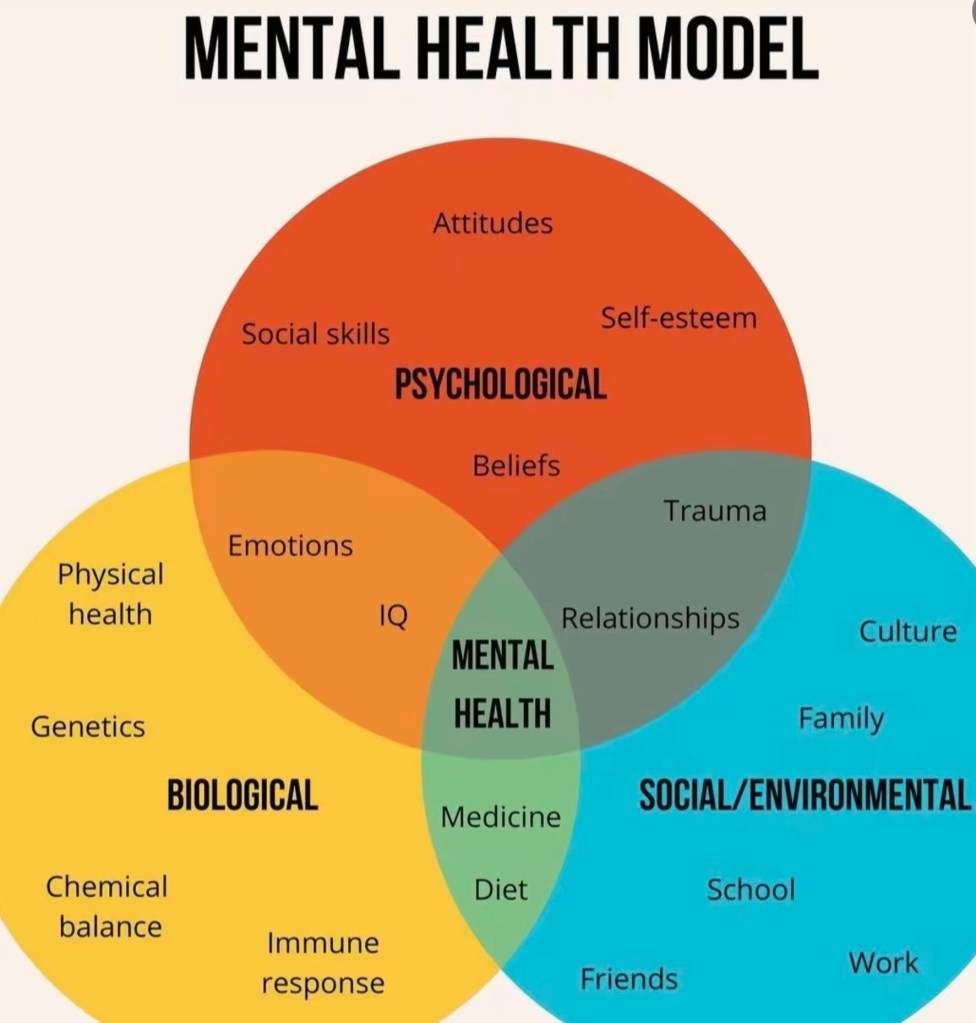
In the tapestry of mental health, various threads interweave to create a picture of well-being that is as complex as it is colorful. The Mental Health Model, as depicted in the image, illustrates the confluence of three fundamental aspects: the psychological, the biological, and the social/environmental. Each domain contributes uniquely to our mental health, and their interplay can determine the overall quality of our mental and emotional life.
The Psychological Sphere
This domain is a vibrant mix of our attitudes, social skills, self-esteem, emotions, beliefs, and intelligence quotient (IQ). It represents the internal mechanisms that govern our responses to the world. Healthy psychological functioning is characterized by a balanced self-view, adaptive coping strategies, and constructive social interactions. Yet, when distorted by negative self-talk or unrealistic beliefs, this sphere can lead to a range of mental health issues.
The Biological Foundation
Here lies the bedrock of our mental health, consisting of genetics, chemical balance, and immune response. It’s a reminder that mental health is not solely a matter of will or character, but often rooted in the very fabric of our being. Advances in neuroscience and psychopharmacology underscore the importance of this sphere, acknowledging that sometimes, the path to mental well-being is through biological intervention.
The Social/Environmental Context
This encompasses our relationships with family and friends, our schooling, and our work environment. These factors can either support or undermine our mental health. A nurturing family, positive friendships, fulfilling work, and an inclusive school environment can significantly bolster our well-being. Conversely, toxic relationships, bullying, job stress, or an unsupportive educational setting can be detrimental.
Interconnectivity: The Overlapping Realms
The beauty of the model lies in its interconnectivity. Stress at work (social/environmental) can lead to insomnia (biological), which in turn can affect our mood and cognition (psychological). Similarly, a genetic predisposition (biological) might be mitigated by strong social support and adaptive coping skills (psychological and social/environmental).
Engaging with the Model
Understanding this model is the first step. The next is engagement. We must nurture each sphere through self-care, medical intervention when necessary, and building robust social networks. Recognizing when one aspect is out of balance and seeking appropriate help is key.
Nurturing the Psychological Sphere
Mindfulness and gratitude are powerful tools for psychological health. Begin or end your day with a brief session of mindfulness meditation to ground your thoughts and soothe your emotions. Complement this by maintaining a gratitude journal, jotting down a few things you’re grateful for daily, which can shift your focus to the positive aspects of life. Additionally, allocate time each week to learning a new skill or engaging in a hobby. This not only boosts cognitive function but also enhances self-esteem through the achievement of personal milestones.
Strengthening the Biological Foundation
Physical activity is essential for mental wellness. Aiming for 30 minutes of exercise on most days can elevate your mood and improve your energy levels. Nutrition also plays a critical role; a balanced diet, particularly one including omega-3s, whole grains, and vegetables, supports overall brain health. Lastly, prioritizing good sleep hygiene by establishing a regular sleep schedule supports your body’s natural rhythms and chemical balance, essential for mental health.
Enhancing the Social/Environmental Context
Fostering strong connections with family and friends provides a supportive network that is invaluable for mental health. Make an effort to reach out regularly, whether through a simple message or a scheduled catch-up. In your work environment, create a space that is both functional and personal, filled with items that spark joy and inspiration. Beyond personal spaces, seek to engage with your broader community through clubs or volunteer work, enhancing your sense of belonging and purpose.
Interconnecting Daily Practices
Leveraging technology can be beneficial when it comes to managing holistic health. Use apps to monitor and encourage healthy habits in sleep, diet, and activity. Effective time management is another key practice; it allows you to balance work, leisure, and self-care. And remember, there is strength in seeking help. If you find any aspect of your mental health is consistently challenging, professional guidance from a therapist or counselor can be vital in restoring balance.
By integrating these strategies into your everyday life, you can actively promote each dimension of your mental health, leading to a more balanced and fulfilling existence.
Conclusion
As we navigate the complexities of mental health, the model provides a map. It’s an invitation to holistic care, a balanced life, and ultimately, harmony. It’s a call to action, encouraging us to tend to all facets of our being to achieve the fullest expression of health and happiness.
 Mosaic Musings
Leave a comment