
The story of Astronomer’s Epiphany
In a small observatory perched on a hill, there lived an astronomer named Eli. His life was dedicated to collecting data about the stars. Night after night, he charted their positions, logged their brightness, and categorised them by size and colour . His knowledge was vast; his observatory walls were lined with volumes of data on celestial bodies.
One clear evening, while studying a familiar patch of sky, Eli had a visitor, his young niece, Lila. She gazed into the telescope with wonder, then at the walls plastered with data. “Uncle,” she asked, “with all these stars you know, have you found your favorite constellation?”
Eli paused, realizing that, amidst his data collection, he had never considered the patterns. The stars were just numbers and facts to him. That night, Lila grabbed a handful of Eli’s star charts and began to draw lines between the points, creating shapes and figures. She crafted stories for each formation, giving life to the data her uncle had so meticulously gathered.
As the night waned, Eli looked through the telescope again, this time seeing past the individual stars. He saw the Great Bear, the Hunter, and the Queen’s Crown, the constellations that Lila had playfully mapped out, turning his fragmented knowledge into a tapestry of intelligence.
From that moment on, Eli’s approach to astronomy changed. He began to understand the sky not just as a collection of data points but as a grand story written in stars, each constellation telling a part of a greater narrative. He found connections between the distance of stars and their life cycles, between their compositions and the history of the cosmos.
The Realm of Knowledge
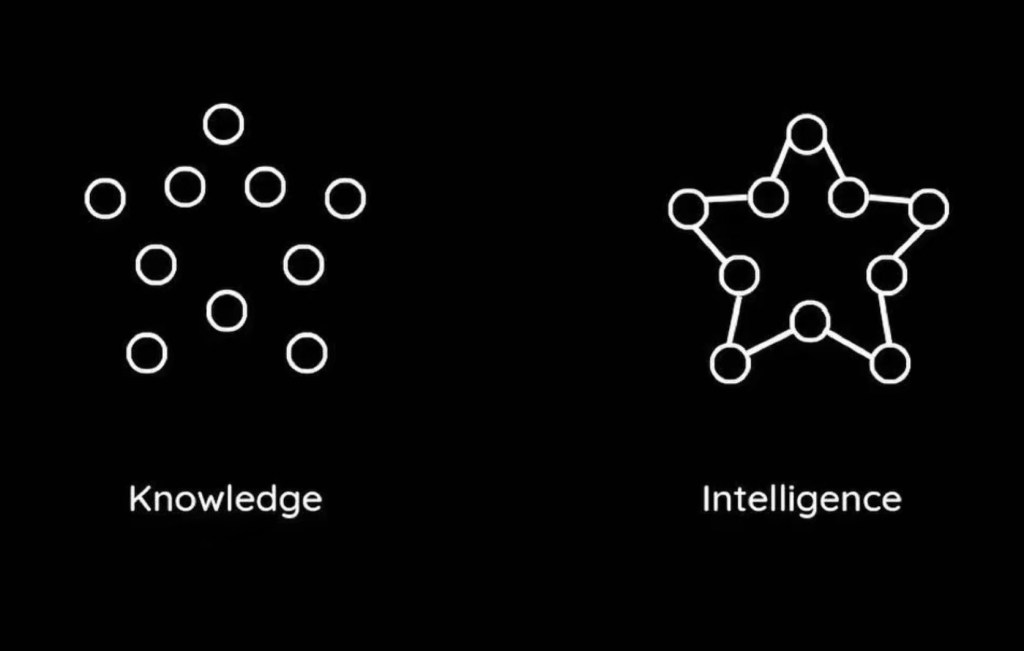
Knowledge is often visualised as an accumulation of facts, like stars scattered across the night sky. Each point of light represents a datum, a solid piece of information. It is the raw material of our understanding, amassed through observation, study, and experience. But knowledge alone is like an uncharted galaxy—vast, perhaps beautiful, but lacking context and connection.
The Essence of Intelligence
Then comes Intelligence, the force that draws lines between these points, creating constellations where there was only chaos. Intelligence is the ability to connect dots, to weave disparate pieces of knowledge into coherent patterns. It discerns relationships, crafts meaning, and forges understanding. The interconnected star in the image represents this synthesis, the dynamic structure that gives form to the formless.
Interplay Between Knowledge and Intelligence
Can there be intelligence without a foundation of knowledge? And what good is knowledge if it remains unconnected, unused? The relationship is symbiotic. Knowledge feeds intelligence, and intelligence gives purpose to knowledge. It’s not enough to know; one must also understand.
The Gestalt of Comprehension
The gestalt theory of psychology posits that the whole is greater than the sum of its parts. This concept resonates deeply with the image. The individual circles of knowledge become significant only when the lines of intelligence are drawn to reveal the bigger picture. The ‘star’ is not just a collection of points; it is a new entity, a pattern that stands for something greater.
The Challenge for Educators and LearnersFor educators, the challenge lies in not just imparting knowledge but in fostering intelligence. How do we encourage students to draw their own connections, to form their own constellations? And for learners, the task is to remain open to seeing the lines between the dots, to engage actively with information so that it becomes ingrained wisdom.
Conclusion
This simple dichotomy between knowledge and intelligence encapsulates the essence of human progress. As we sail through the information age, where knowledge is more accessible than ever, the true currency has become the ability to transform that knowledge into intelligence. In the circles and stars, we find a reflection of our potential, a reminder that our capacity to understand is boundless when we dare to connect the dots.
Ending where we started, Eli’s epiphany, sparked by Lila’s innocent inquiry, illustrates the transition from knowledge to intelligence. His knowledge of the stars was profound, but it took a child’s imagination to connect the dots and reveal the constellations. This story echoes the blog’s message:
knowledge is the canvas, but intelligence is the artistry that gives it meaning and beauty. In this story, Eli’s wealth of knowledge finds its true value when Lila introduces the element of intelligence, transforming raw data into patterns and stories that resonate with meaning.
 Mosaic Musings
Leave a comment